

Shop all our available wines now online.
Back to blog
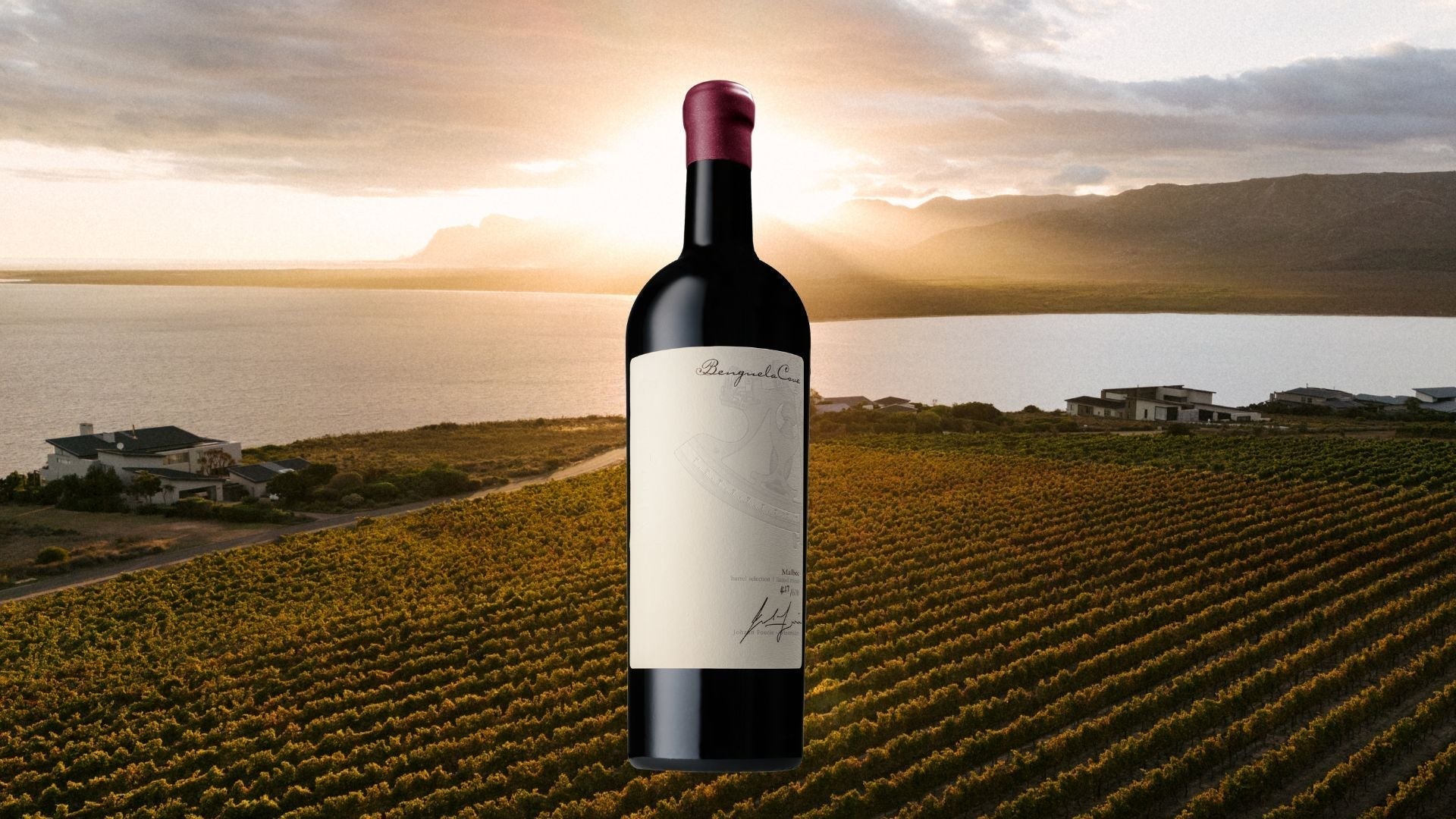
How Malbec Grows in Cool-Climate Walker Bay
Posted by Benguela Cove Investments On 2025-11-25T09:11:54Z
Discovering Argentina's Grape in South Africa's Unique Terroir
When people think of Malbec, they think of Argentina. Mendoza's high-altitude vineyards and intense sunshine have made the variety world-famous. So why would we plant Malbec at sea level in Walker Bay, where ocean mists roll in and temperatures stay cool?
The answer lies in what makes Benguela Cove different – and why our Vinography Malbec 2023 is unlike any other South African Malbec you've tasted.
The Malbec Journey: From France to Argentina to Walker Bay
Malbec's story begins in Cahors, France, where it was called "the black wine" for its inky dark colour. When phylloxera devastated European vineyards in the late 1800s, Malbec found a new home in Argentina's sunny highlands, where it thrived and evolved into the bold, fruit-forward style we know today.
But what if Malbec could express something entirely different? What if, instead of baking in mountain sun, it grew at the ocean's edge, cooled by Antarctic currents?
That's the experiment we began at Benguela Cove in 2006 when we planted our first Malbec vines in virgin soil just three meters above sea level.
Why Cool-Climate Matters
Temperature is everything in winemaking.
In hot climates, grapes ripen quickly. Sugar accumulates fast, acids drop, and you get powerful, high-alcohol wines with ripe, jammy fruit. That's the classic Argentine style, and it has its place.
But in cool climates like Walker Bay, something magical happens. Ripening slows down. The grapes have time – weeks longer than in warm regions – to develop complexity while retaining natural acidity. The result? Wines with more structure, more elegance, more nuance.
Our Malbec vines benefit from what we call "Goldilocks conditions" – not too hot, not too cold, just right.
The Benguela Current: Antarctica's Gift to Our Vineyards
Stand in our Malbec vineyard on a summer morning, and you'll feel it – the cool breeze rolling in from the Atlantic Ocean. This isn't just any breeze. This is air cooled by the Benguela Current, a cold water system that flows north from Antarctica along the western coast of South Africa.
The current has been cooling Walker Bay for millennia, creating a unique mesoclimate that's more like Burgundy or the Willamette Valley than traditional Malbec country.
Here's what this means for our Malbec:
Long Growing Season: Our Malbec ripens slowly over 4-5 months, compared to 3 months in warmer regions. More hang time equals more flavour development.
Retained Acidity: Cool nights preserve natural acids. This gives our Malbec freshness and aging potential – you can cellar this wine for 8-12 years.
Balanced Alcohol: We achieve full ripeness at 13.5-14% alcohol, rather than the 15-16% common in warmer areas. The wine feels balanced, not heavy.
Complex Flavour Profile: Instead of just ripe blackberry and plum, we get layers – dark cherry, violet, black pepper, graphite, and a distinctive saline minerality from our proximity to the ocean.
Terroir: More Than Just Temperature
Cool climate is just part of the story. At Benguela Cove, our Malbec vines grow in distinctive terroir that shapes every aspect of the wine.
Soil Composition
Our vineyards sit on ancient shale with clay-rich subsoils. Shale drains well but retains just enough moisture to sustain the vines through our warm, dry summers. The clay subsoil provides minerals that contribute to the wine's complex flavour profile.
Importantly, these are virgin soils – first planted in 2006. The vines are still learning their place, still developing the deep root systems that will make truly great wine. Each vintage, they dig deeper, finding new expressions of this unique site.
Altitude and Aspect
At just three meters above sea level, we have the lowest-altitude vineyard in South Africa. You might think low altitude means warm temperatures, but the opposite is true. Our proximity to the ocean means constant maritime influence – cooling breezes, morning mists, and moderated temperatures.
Our Malbec blocks face south and southwest, capturing morning sun but avoiding the intense afternoon heat. This orientation is critical for maintaining the cool-climate character we're seeking.
Ocean Influence
We have 2.7 kilometres of oceanfront vineyards – the longest stretch in South Africa. This isn't a marketing claim; it's a tangible advantage. The ocean acts as a giant temperature regulator, warming cool mornings and cooling warm afternoons.
But there's more: the ocean contributes a saline quality to our wines. When you taste our Malbec, that subtle minerality, that hint of the sea – that's Walker Bay expressing itself through the grape.
Growing Malbec: The Practical Challenges
Cool-climate Malbec isn't easy. The variety is naturally vigorous and can overcrop if not carefully managed. In warm climates, excess crop ripens anyway. In our climate, overcropping means underripe, herbaceous wines.
Our Approach:
Low Yields: We limit our Malbec to 6-8 tons per hectare, roughly half what the vines could produce. Every cluster matters.
Canopy Management: Regular leaf thinning around the fruit zone to improve sun exposure and air circulation, reducing disease pressure in our humid maritime climate.
Cluster Thinning: Dropping 20-30% of clusters in early summer to ensure the remaining fruit ripens fully.
Harvest Timing: This is critical. Too early and we get green tannins and vegetal notes. Too late and we lose acidity. We taste daily in late March, waiting for that perfect moment when fruit ripeness meets phenolic maturity.
Selective Picking: We harvest in the cool early morning and go through the vineyard multiple times, taking only the best clusters.
In the Cellar: Respecting the Fruit
After all that work in the vineyard, our cellar approach is relatively hands-off. We want the cool-climate character to shine through.
Fermentation: Small-batch fermentation in open-top fermenters allows for gentle punch-downs and cap management. We use a combination of ambient and selected yeasts to add complexity.
Oak Aging: 14 months in French oak barrels, 30% new. The oak is there to add structure and spice, not to dominate the fruit.
Blending: The 2023 Vinography Malbec is 100% Malbec. No blending necessary – the wine stands beautifully on its own.
What Makes Our Malbec Different
If you're expecting Argentine-style Malbec – ripe, extracted, fruit-bomb – our wine will surprise you.
Vinography Malbec 2023 is:
- Structured rather than soft
- Elegant rather than powerful
- Mineral alongside fruity
- Fresh despite being red
- Complex rather than straightforward
It's more Right Bank Bordeaux than Mendoza. It's Malbec reimagined through the lens of Walker Bay's unique terroir.
Tasting Notes: Vinography Malbec 2023
Appearance: Deep ruby with purple edges. Dense but not opaque.
Nose: Black cherry, violet, black pepper, and graphite. As it opens, notes of dark plum, bay leaf, and sea breeze emerge. There's a savoury quality here – olive tapenade, charred meat, smoke.
Palate: Medium to full-bodied with fine-grained tannins. The fruit is dark and concentrated but not jammy – black cherry, blackberry, cassis. The mid-palate shows beautiful integration of fruit, oak, and acidity. That distinctive saline minerality appears on the finish, along with black pepper and dark chocolate.
Finish: Long, structured, savoury. This is a wine that evolves in the glass over hours.
Aging Potential: Drink now through 2035. The wine has the structure and acidity to age gracefully.
Food Pairing
The elegance and structure of our Malbec make it incredibly food-friendly. Try it with:
- Grilled ribeye or sirloin – the wine's tannins love fat
- Braai favourites – boerewors, lamb chops, sosaties
- Mushroom dishes – the earthiness matches the wine's savoury character
- Aged hard cheeses – Parmesan, aged Gouda, mature Cheddar
- Game meats – ostrich, springbok, venison
Why 2023 Was Special
The 2023 vintage was exceptional in Walker Bay. A cool, dry summer with no heat spikes allowed for gentle, even ripening. We harvested in perfect conditions – cool mornings, no rain, healthy fruit.
The result is a Malbec that captures everything we hoped this variety could be in our unique terroir. This is a wine we're incredibly proud of – and with only 2,400 bottles produced, it's a limited opportunity to experience cool-climate Malbec done right.
The Bigger Picture: Benguela Cove's Vinography Range
Our Vinography range represents our flagship wines – single-vineyard expressions that showcase specific parcels on our estate. Each wine is a journal entry, recording the interaction between nature and winemaking in a specific place and time.
The Malbec joins our Vinography lineup alongside:
- Cabernet Sauvignon (Best Wine of Show, Michelangelo International Wine & Spirits Awards 2025)
- Chardonnay
- Sauvignon Blanc
Together, these wines tell the story of what's possible when you combine cool-climate viticulture with obsessive attention to detail.
Experience It Yourself
Words can only do so much. To truly understand how Malbec grows in cool-climate Walker Bay, you need to taste it.
Visit Us: Book a tutored tasting at our estate, where you can compare our Malbec to other Vinography wines and see the vineyards where it all begins.
Shop Online: The Vinography Malbec 2023 is available now at shop.benguelacove.co.za with free delivery on 6+ bottles.
Join Our Wine Club: Members get first access to all new releases and limited-production wines like our Vinography range.
Benguela Cove Lagoon Wine Estate is a WWF Conservation Champion. Our 2.7km of oceanfront vineyards produce cool-climate wines that express the unique terroir of Walker Bay.